
My 7-year-old outgrew ScratchJr in 15 minutes. He wanted enemies that chase, doors that need keys, a boss with two moods. So I built him a real game engine and hid it inside a sticker book.
Kids drag hand-painted stickers into a 3D paper world and snap real WHEN → DO rules onto them. Starts at six. No wall at ten.
My 7-year-old outgrew ScratchJr in 15 minutes. He wanted enemies that chase, doors that need keys, a boss with two moods. So I built him a real game engine and hid it inside a sticker book.
These aren't videos. The real engine and the real 3D paper renderer are running on this page — and every game here ships in the app for kids to crack open and remix.
Every game is a papercraft diorama. Grab any game on this page and drag — you're holding the shoebox.
Every character is painted in gouache and die-cut — art, white sticker edge, ink outline — standing up in the world.
The ground is a corrugated slab. Platforms are stacked and glued like a shoebox diorama. Walk to the fence — the table falls away.
Characters ride little wooden hand-sticks, like kids under the stage are playing the whole game. Watch one turn around — the stick twirls.
The sheets breathe, gallop when they run, stretch mid-jump, squash on landing. The paper is the animation.
Three moves. The third one is the secret.
Heroes, dragons, coins, trees — each one pops up as a paper cutout in the diorama. Draw your own and it stands up too.
Chase the hero. Be a coin. Be a door. Snap a power on, press play — it just works.
Every power opens into WHEN → DO rule cards a kid can read and change — or they forge a brand-new power and name it themselves.
Tap a character in a real game and read its actual brain. No code they can't see. No AI writing it for them.
👇 Tap anyone in Bubble Keeper
Octo
2 rules inside — every one a kid can read
👀 Read one out loud with your kid: "When I'm tapped, lose a heart, shake the screen, and say hee hee." That's the whole game — and they wrote it.
Flip on the Brain while playing and the rules light up as they fire. A real debugger, sized for a seven-year-old.
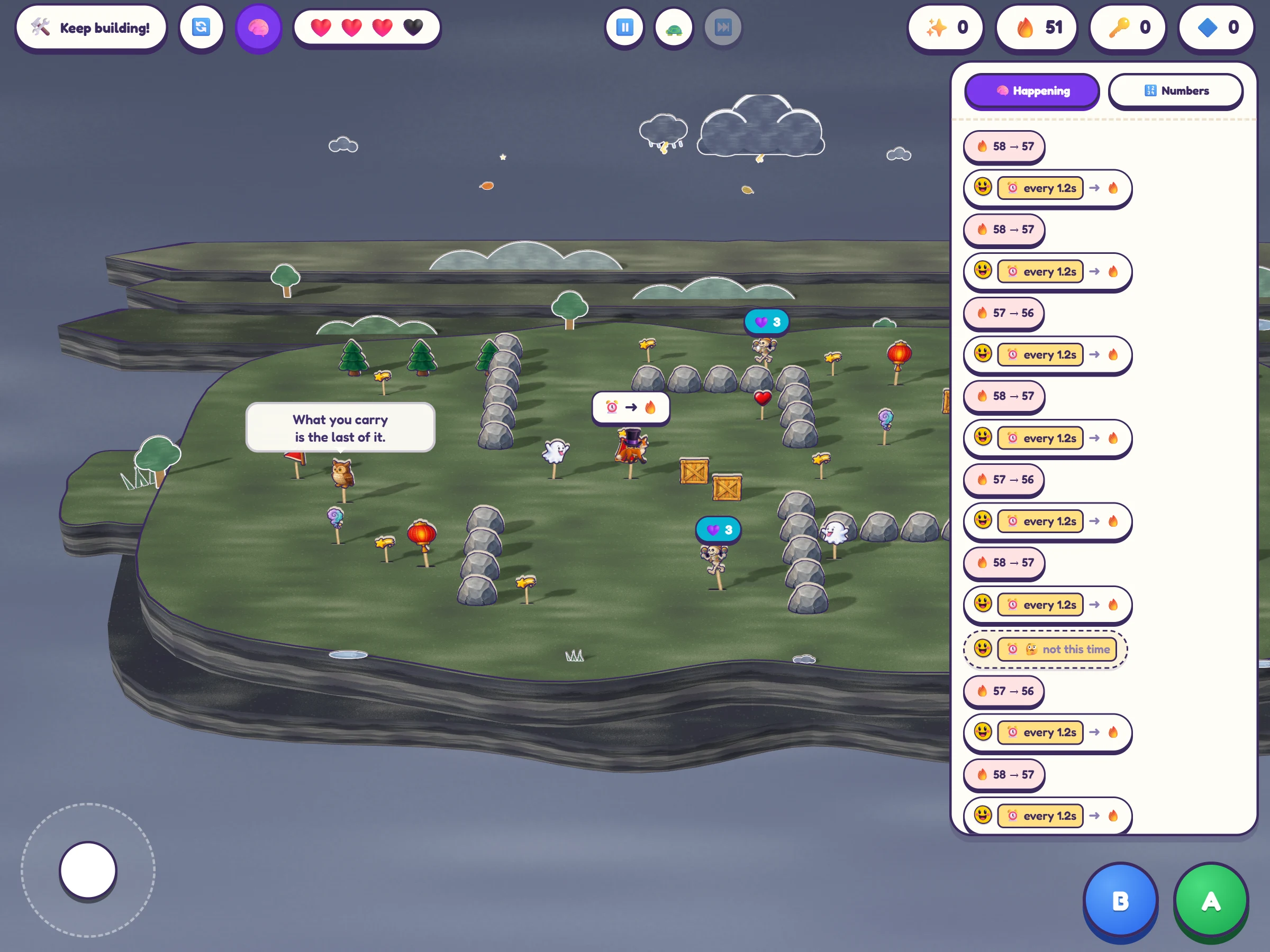
⏸️ Pause the world and poke at it — every character's rules, frozen mid-thought.
🐢 Slow it to a crawl and watch the WHEN pills flash the moment they're true.
⏭️ Step one moment at a time when a rule doesn't do what they expected — that's debugging, age seven.
They don't just make the game. They understand it.
Home isn't a menu — it's the Adventure Trail, a papercraft overworld your kid explores as their own hero.
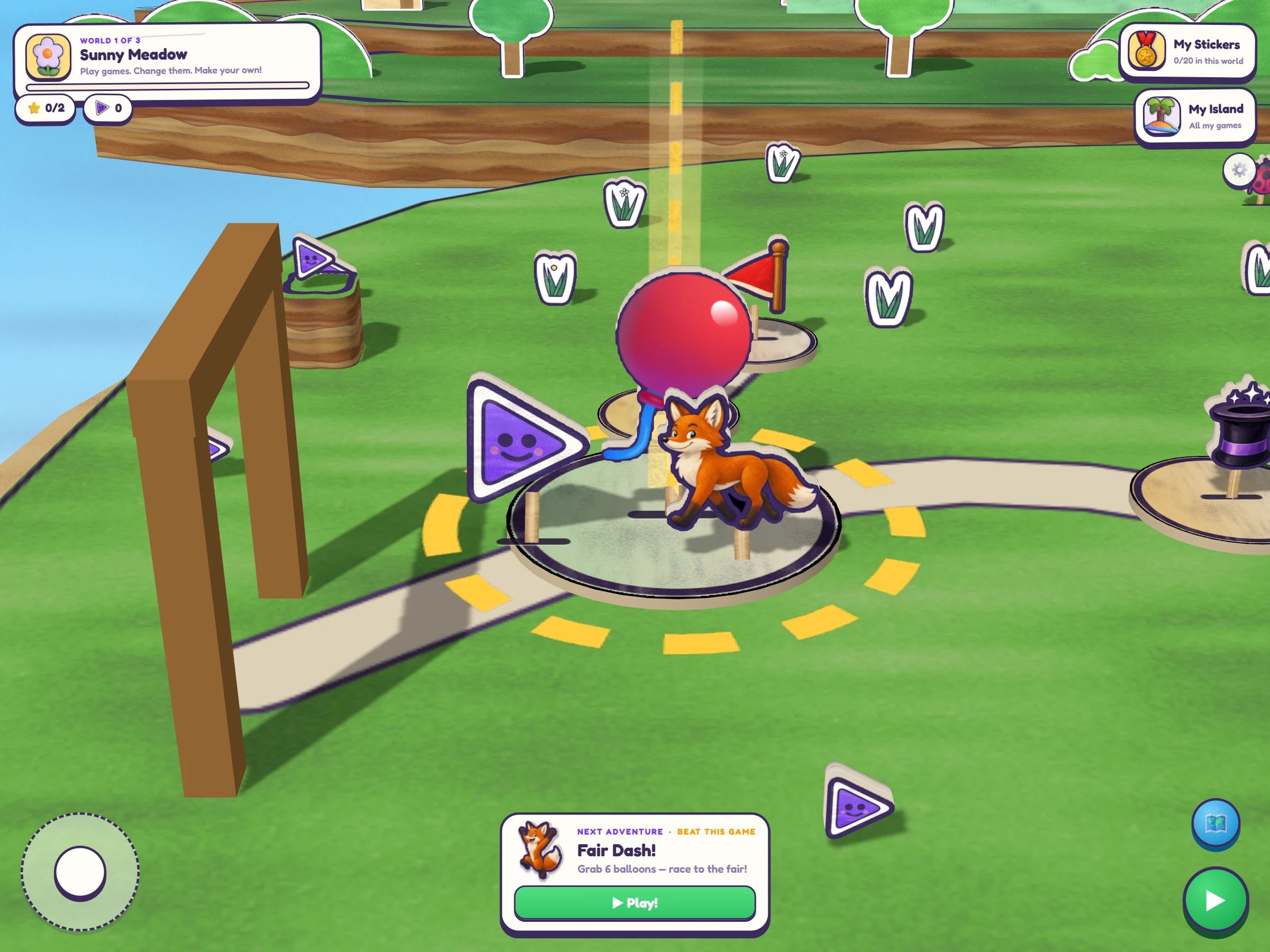
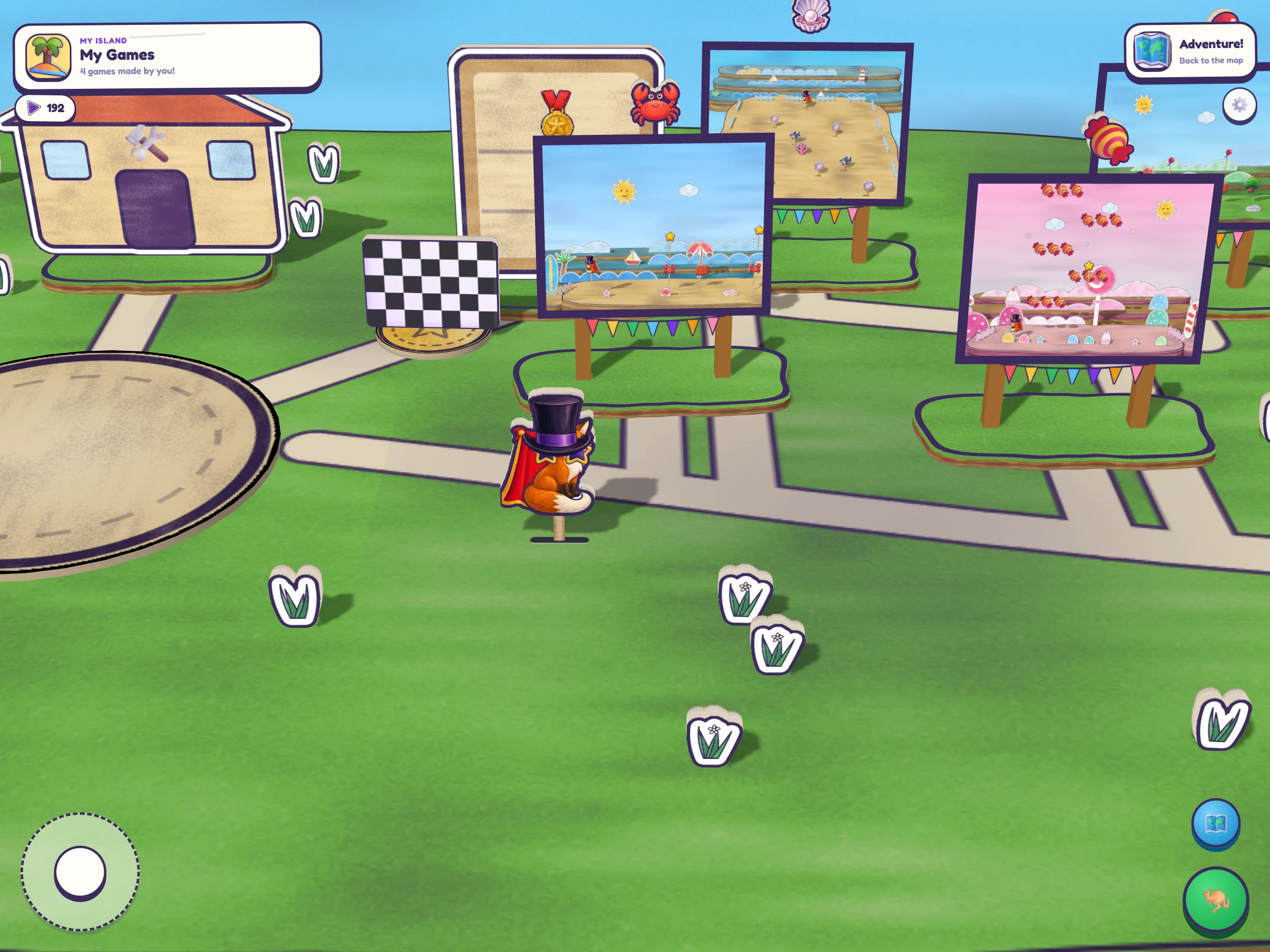
The engine speaks a full game-engine schema from day one — the kid-friendly part is just how much of it we show at once.
A wonderful first step that ends fast — its own reviews beg for more.
One power on day one. Rule cards by week two. Counters, modes, signals, multi-room worlds, boss logic when they're hungry for it — same app, same game.
WHEN → DO thinking is already in their bones. They arrive at home — not behind.
The Last Ember is a seven-room adventure — a lamp that is your life and your ammo, an economy, a warp network, an auto-scrolling chase, a three-phase boss — built from exactly the powers and rule cards your kid gets. No secret engine features. It ships in the app, crack-open-able like everything else.
Not a demo reel — the actual app that ships on iPad, 3D editor and all. First game before you finish your coffee.
▶ Open the studio — free, no signupBuilt by a parent, so the worry list got engineered away first.
Everything lives on the iPad. No servers, no strangers, no chat. Perfect on a plane.
No accounts, no ads, no third-party trackers. Anonymous crash-and-usage counters — ours alone, nothing that identifies your kid — are the only thing that ever leaves the device. The privacy policy is short and honest.
AI app-makers build the game for your kid. Here the kid writes the logic — and the Brain shows it thinking.
Free to try with the full toolkit. One unlock opens everything, forever — Family Sharing included.
The free app is the whole toolkit with a small shelf. The unlock makes the shelf bottomless.
🎈 Free
$0
the whole toolkit, a small shelf
🎁 Whole Workshop
$14.99$19.99
once — launch price, Family Sharing on
🚫 never a subscription · never ads · never a nag screen
"What comes after ScratchJr?" is the question we're built to answer. SceneBeans Classroom brings the same engine to Chromebooks.
Built for roughly 6–10. The floor is "can drag a sticker" — icons first, every word read-aloud simple. The ceiling is the part we're proudest of: counters, modes, signals, multi-room worlds — a motivated 10-year-old keeps finding depth instead of graduating out.
It's engineered for iPads first: the paper world draws in a handful of GPU batches — five hundred coins costs about two draw calls, not five hundred. If your browser can run this page, it runs the studio.
Really. Free download, one optional $19.99 unlock ($14.99 launch price), done. Optional $2.99 world packs come later — one-time too, behind a parental gate, never nagged. We think the subscription-ification of kids' apps is why parents are mad at all of them.
ScratchJr is a brilliant first step that ends fast — sequential scripts, four screens, animations more than games. Full Scratch assumes fluent reading and typing patience. SceneBeans is the missing rung: rule-based logic (WHEN → DO, like real engines) with zero reading walls, making actual playable 3D games with physics, enemies, and win conditions.
No accounts, no ads, no third-party trackers, and the app works with WiFi off. The only thing that ever leaves the device is anonymous crash-and-usage counting on our own servers — nothing that identifies your kid, ever. The privacy policy is short on purpose.
No — and that's a hill we'll stand on. Every sample game (including the seven-room epic above) is built from the same powers and rule cards kids use. AI app-builders hand kids a finished black box; SceneBeans hands them the logic. "My kid understands the game they made" is the entire product.